


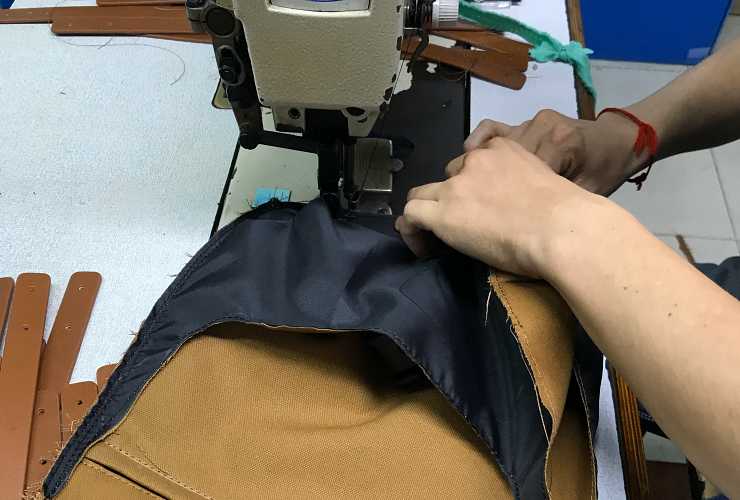
For outdoor brands, travel gear labels, and technical tech-wear startups across the US, Europe, Australia, Japan, and Korea, specifying the wrong shell fabric in a techpack is one of the most expensive mistakes a product manager can make. Choosing between Nylon and Polyester isn’t just a matter of price per yard—it dictates the bag’s tear strength, UV resistance, weight, and overall longevity.
When transitioning from initial sketches to production-ready techpacks, selecting the wrong material can lead to catastrophic field failures, such as tearing under load or rapid UV degradation.
As an expert product development team and leading travel backpack manufacturer in Vietnam, MIMICRY SAI GON breaks down the exact material performance metrics, technical trade-offs, and techpack specification guidelines to ensure your travel bag line succeeds in the market.
Understanding the Basics: Synthetics in Soft Goods Engineering
Both Nylon (Polyamide) and Polyester (Polyethylene Terephthalate) are petroleum-derived synthetic polymers widely utilized in technical soft goods. However, their molecular structures impart distinct physical properties that directly affect how a bag performs under stress.
When drafting techpacks for private label travel bags, specifying fabric density (measured in Denier, or “D”) alone is insufficient. A 600D Polyester fabric behaves completely differently from a 500D Nylon fabric. Therefore, understanding the inherent characteristics of each fiber is vital before finalizing your bill of materials (BOM).
5 Critical Technical Comparisons: Nylon vs. Polyester
To help brands make data-driven decisions during the product development phase, our material engineers evaluate fabrics across five essential performance criteria:
1. Abrasion Resistance & Tensile Strength
Travel backpacks endure harsh handling, from airline baggage conveyors to rough outdoor surfaces.
-
Nylon: Exhibits superior tensile strength and abrasion resistance compared to Polyester at equivalent thread counts. Spliced Nylon fibers stretch under extreme tension before breaking, absorbing heavy shock loads.
-
Polyester: While sufficiently durable for urban commute packs, Polyester has lower tear resistance under high-stress conditions.
-
Techpack Advice: For high-wear zones (such as bag bases, shoulder strap anchor points, and drag handles), specifying high-tenacity Nylon or branded fibers like Cordura is recommended.
2. Moisture Absorption & Hydrophobic Behavior
Weather resistance is a non-negotiable requirement for modern travel gear.
-
Polyester: Inherently hydrophobic (absorbs less than 0.4% moisture). It repels water naturally, dries rapidly, and resists mildew formation.
-
Nylon: Slightly more hydrophilic (absorbs around 2–4% moisture). When saturated, uncoated Nylon can become heavier and temporarily lose tensile strength.
-
Techpack Advice: For this reason, when specifying Nylon for weather-resistant travel packs, always mandate a Polyurethane (PU) or Thermoplastic Polyurethane (TPU) backing coat paired with a Durable Water Repellent (DWR) finish on the face.

3. UV Resistance & Colorfastness

Long-term exposure to sunlight affects fabric integrity and aesthetic appearance.
-
Polyester: Exceptional resistance to ultraviolet (UV) radiation. It maintains color vibrancy and structural strength even after prolonged sun exposure.
-
Nylon: Susceptible to UV degradation over extended periods, which can lead to fading and fiber embrittlement unless UV-inhibiting treatments are applied during the dyeing process.
-
Techpack Advice: For expedition gear and digital-nomad travel packs designed for outdoor environments, Polyester offers better long-term colorfastness, whereas UV-stabilized Nylon should be specified for high-performance outdoor applications.
4. Fabric Weight & Flexibility
Packs designed for carry-on travel require an optimal strength-to-weight ratio.
-
Nylon: Features a lower specific gravity than Polyester, making it lighter at equivalent strength thresholds. Its subtle elasticity allows stuffed compartments to expand slightly without blowing out seams.
-
Polyester: Possesses a stiffer hand-feel with minimal elongation. While this helps unstructured bags maintain their shape, it adds slight bulk to large-capacity packs.
5. Cost Structure & Production Efficiency

Material selection directly impacts unit economics and target retail pricing.
-
Polyester: Significantly less expensive to synthesize, weave, and dye. It offers cost efficiency for mid-tier consumer markets or large-volume production runs.
-
Nylon: Involves higher raw material costs and specialized processing, resulting in a higher price per meter.
Technical Comparison Matrix for Techpack Drafting
To streamline your specification process when creating techpacks for private label travel bags, consult this engineering breakdown:

How MIMICRY SAI GON Eliminates Material & Techpack Errors
Navigating material selection, sourcing certified mills, and validating technical techpacks requires deep manufacturing expertise. As an established travel backpack manufacturer in Vietnam, MIMICRY SAI GON acts as an end-to-end technical partner for international brands.
MIMICRY SAI GON — Your trusted local partner
Collaborating with you on bags/backpack design, product development, factory sourcing, quality control, and cost optimization.
Are you looking to optimize costs, shorten product development time, and still ensure quality?
Mimicry Saigon is more than just a supplier; we are your strategic product development partner in Vietnam.
With our core strengths in transparent design and supply chain management, we specialize in transforming your handbag and backpack ideas into high-quality, cost-effective, and market-ready products. In addition, we offer comprehensive services from concept development and design to direct factory sourcing (eliminating intermediaries), rigorous quality control, and fast delivery.
Contact us today via MIMICRY SAI GON for a free consultation on how we can realize your vision and leverage Vietnam’s leading manufacturing capabilities.
Comprehensive Service Offerings:
-
Core Services:
-
Handbag and backpack design
-
Product development & Techpack creation
-
Direct factory sourcing
-
-
Extended Services:
-
Brand identity design
-
Technical packaging design and consulting
-
Rigorous quality control (Inline and AQL inspections)
-
Fast delivery & supply chain logistics
-
Whether you require custom fabric sourcing for specialized private label travel bags or comprehensive 3D pattern development, our technical team ensures your designs transition smoothly from initial sketch to final container shipment.
Conclusion: Making the Right Material Choice
Deciding between Nylon and Polyester depends on your product’s performance requirements, target market, and price positioning. Ultimately, Nylon is the ideal choice for heavy-duty, ultra-lightweight, and technical travel packs where maximum durability is essential. Conversely, Polyester offers a cost-effective, UV-resistant solution for urban travel bags and lifestyle daypacks.
Moreover, partnering with an experienced manufacturing team in Vietnam eliminates guesswork, ensuring your techpacks are properly specified before bulk production begins.
Ready to transform your bag sketches into market-ready technical packs? Visit MIMICRY SAI GON today to consult with our product development experts.