

For outdoor equipment brands, travel gear labels, and technical tech-wear startups across the US, Europe, Australia, Japan, and Korea, bringing a new bag to market often starts with a benchmark product rather than a completed techpack. Whether you want to improve an existing competitor’s design, re-engineer a vintage carry-on, or reproduce a discontinued military pack, one major question arises: Can you replicate a bag without a techpack?
The short answer is yes. Through a systematic process known as Reverse Engineering, a specialized technical partner can deconstruct a physical sample, analyze its internal framework, extract precise vector patterns, and construct a complete, factory-ready techpack.
However, many B2B product managers fear this process. The worry of receiving an inaccurate replica—with poor weight distribution, weak seams, incorrect fabric tension, or compromised structural integrity—is high.
As a premier local product development partner and Cordura bag supplier Vietnam specialist, MIMICRY SAI GON bridges this gap. We turn physical samples into production-grade techpacks with zero loss in quality or performance.
What Is Reverse Engineering in Bag Manufacturing?

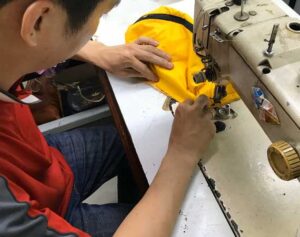
Reverse engineering soft goods is the process of dissecting a physical bag to create a comprehensive technical blueprint (Techpack) and digital pattern library.
When a brand lacks digital CAD patterns, Bill of Materials (BOM) documentation, or dimension specifications, reverse engineering acts as the technical bridge to mass production.
The Standard Reverse Engineering Workflow:
-
Physical Deconstruction & Measurement: Measuring exterior dimensions, pocket volumes, strap angles, and hardware positioning.
-
Material & Hardware Auditing: Testing fabric denier (e.g., Cordura 500D vs. 1000D), tensile strength, lining weights, foam densities, and zipper specs.
-
Pattern Extraction (Digitization): Tracing individual panel shapes to generate 2D vector CAD patterns.
-
Techpack Generation: Creating a full manufacturing file including exploded assembly views, seam allowances, and stitching callouts.
Replicating a Bag Without a Techpack: Key Technical Challenges
While replicating a bag without a techpack is possible, it is not as simple as cutting up a physical sample and tracing around the edges. Fabrics behave dynamically under tension, load, and environmental conditions.
Without expert engineering, unguided replication leads to severe manufacturing errors:

1. Fabric Stretch & Bias Distortion
Woven materials like Cordura, Kevlar, and Ripstop Nylon stretch differently along the warp, weft, and bias. Deconstructing a used or stressed physical sample can lead to distorted pattern pieces if the engineer does not account for material memory and relaxation.
2. Hidden Internal Architecture
Technical travel bags and tactical backpacks rely on complex internal structures—such as HDPE frame sheets, EVA foam layers, hidden reinforcement webbing, and bound seam allowances. Missing a hidden reinforcement strip can cause early structural failure under load.
3. Compliance & Travel Ergonomics
Travel backpacks and carry-on gear designed for international transit must comply with strict dimensional limits set by aviation bodies like IATA. Replicating a bag without verifying its packed dimensions against global carry-on guidelines can result in products that fail real-world travel requirements.
Comparison: Replicating From Scratch vs. Reverse Engineering
To help product teams evaluate their options, here is how reverse engineering compares to traditional sketch-based development:
| Development Metric | Sketch-to-Techpack (From Scratch) | Reverse Engineering (From Physical Sample) |
|---|---|---|
| Initial Input Required | Detailed design sketches & specs | Physical reference bag/sample |
| Development Speed | 3 to 5 physical revisions needed | 1 to 2 targeted prototype revisions |
| Pattern Accuracy Risk | Higher risk of proportion errors | Very high precision (Direct CAD extraction) |
| Material Sourcing Time | Slower (Selecting from swatches) | Faster (Direct matching against existing sample) |
| Best For | Completely original brand concepts | Upgraded revisions, vintage remakes, benchmark gear |
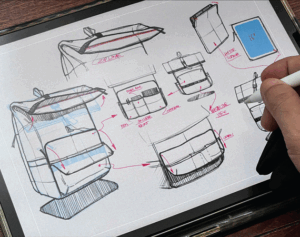
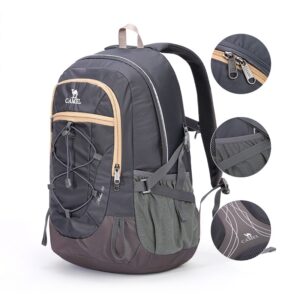
4 Crucial Steps to Flawless Reverse Engineering
To prevent technical mistakes and eliminate the fear of off-spec mass production, MIMICRY SAI GON executes a 4-step technical protocol for every reverse engineering project:
Step 1: Material Identification & Functional Matching
We audit the physical reference product to match exact fabric specifications. Whether sourcing heavy-duty technical materials from a certified Nylon backpack factory or matching abrasion-resistant fabrics through a specialized Cordura bag supplier Vietnam network, we verify fabric weight, coating type (PU vs. TPU), and water resistance levels.
Step 2: 2D Digitization & Seam Allowance Recalibration
Using digital pattern-making software, we digitize every panel piece. We adjust for seam allowances, grainlines, and fabric stretch characteristics to ensure the new pattern yields clean, wrinkle-free assembly on the production line.
Step 3: Hardware & Ergonomic Audit
We inspect every zipper, side-release buckle, D-ring, and sternum strap. If the reference sample uses outdated or non-standard hardware, we recommend modern commercial equivalents (such as YKK or Duraflex) that meet strength requirements while optimizing unit costs.
Step 4: First-Article “Golden Sample” Validation
Once the reverse-engineered techpack is compiled, we produce a counter-sample. This physical sample undergoes stress testing, dimensional audits against IATA travel standards, and seam-strength validation before mass manufacturing begins.
Why Technical Gear Brands Partner With MIMICRY SAI GON
Navigating product development in Southeast Asia requires transparent management, technical expertise, and direct factory control. MIMICRY SAI GON serves as your dedicated, on-the-ground technical development arm in Vietnam.
Are you looking to optimize costs, shorten product development time, and still ensure quality?
Mimicry Saigon is more than just a supplier; we are your strategic product development partner in Vietnam.
With our core strengths in transparent design and supply chain management, we specialize in transforming your handbag/briefcase ideas into high-quality, cost-effective, and market-ready products. We offer comprehensive services from concept development and design to direct factory sourcing (eliminating intermediaries), rigorous quality control, and fast delivery.
Contact us today for a free consultation on how we can realize your vision and leverage Vietnam’s leading manufacturing capabilities.
Our Comprehensive Capabilities:
-
Our Main Services:
-
Handbag and backpack design
-
Product development
-
Factory sourcing
-
-
Extended Services:
-
Brand design
-
Packaging design and consulting
-
Quality control (Inline and pre-shipment AQL inspections)
-
Fast delivery and logistical support
-
Whether you need to reverse engineer a technical outdoor pack with a specialized Cordura bag supplier Vietnam or scale production through a high-volume Nylon backpack factory, our technical engineering team protects your vision from prototype to final container shipment.
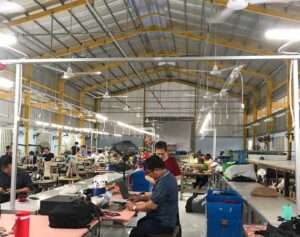
Conclusion: Eliminating the Risk in Bag Replication
Can you replicate a bag without a techpack? Absolutely. But doing it successfully requires more than taking a bag apart—it requires precise pattern digitization, material science expertise, and strict quality control.
By pairing reverse engineering with an experienced local development partner, outdoor brands and tech-wear startups can shorten R&D cycles, eliminate sampling errors, and launch market-ready gear with confidence.
Ready to transform your benchmark sample into a production-ready techpack? Visit MIMICRY SAI GON today to consult with our product development experts.